Quick answer: The easiest and cheapest way of getting around Dublin is a TFI Leap Card. An adult fare is €2 for 90 minutes on Dublin Bus, Luas, DART and commuter rail in the city, and spending stops at €6 a day or €24 a week. Visitors can buy a Leap Visitor Card instead (€8 for 24 hours, €18 for 72 hours, €24 for 7 days). Tap-to-pay with a bank card is not live on Dublin’s buses, trams or trains yet, so get your Leap sorted before you travel.
Sure, half the city is walkable and the other half is a short tram ride away. Still, buses that only take coins can throw a first-timer. Here is every option, with fares checked on the official Transport for Ireland (TFI) and Leap Card websites in October 2026.
Leap Card vs Leap Visitor Card: Which Should You Get?
The standard TFI Leap Card
This is the reusable pay-as-you-go card that Dubliners use. An adult card needs a €5 deposit plus a minimum €5 top-up. You can buy one at more than 2,000 Leap agents, including all post offices, at ticket machines in Irish Rail stations in Dublin, or online. At Dublin Airport, TFI lists WH Smith in Terminal 1 and Spar in Terminal 2.
The Leap Visitor Card
This gives unlimited travel for a set time, starting from your first tap. It covers Dublin Bus and Go-Ahead Ireland city buses, all Luas trams, and DART and commuter rail in Dublin.
- 1 day (24 hours): €8
- 3 days (72 hours): €18
- 7 days (168 hours): €24
You can buy it online (it is posted to you, so allow time), at WH Smith in Terminal 1 (24-hour cards) or Spar in Terminal 2 at the airport, or in the city at the Dublin Bus office at 59 Upper O’Connell Street, the GPO, and several Spar shops on O’Connell Street, Dame Street and Talbot Street. It is not valid on hop-on hop-off tours, other tour buses or Bus Éireann services.
Our honest verdict
Do the maths before you buy. A standard adult Leap Card caps at €6 a day and €24 a week (Monday to Sunday) on city services. That is less than the €8 one-day Visitor Card. On fares alone, a standard Leap is the same price or cheaper, though you pay the €5 deposit on top. The Visitor Card is better if you want no balance to worry about, or if your 72 hours or 7 days run across two calendar weeks.
Fares in 2026 and How the 90-Minute Fare Works
Here are the main adult Leap fares in Zone 1 (TFI Dublin City):
- TFI 90 Minute Fare: €2.00 (Young Adult and Student €1.00, Child €0.65)
- Short Fare (trips of roughly 2–3km): €1.50
- Xpresso and Nitelink buses: €2.40
- Daily cap: €6.00 | Weekly cap: €24.00
The 90-minute fare is charged when you first tap on. After that, any Dublin Bus, Go-Ahead Ireland city bus, Luas or Zone 1 DART and commuter rail trip you tap onto within 90 minutes is free. It does not cover Express or Nitelink buses. Children under five travel free.
Paying cash? An adult cash fare on Dublin Bus is €2.60, and it gets awkward fast. Drivers take coins only: no notes, no bank cards, no phone payments. On the Luas you buy paper tickets from the machine at the stop, which takes coins, notes and cards. You cannot buy a ticket on board the tram.
Can I just tap my bank card?
Not yet. Contactless bank card and phone payment is being rolled out on some TFI Local Link rural services, but not on Dublin Bus, Luas or DART. According to the Government’s latest timeline, Dublin is due to switch on contactless payment across all modes in summer 2028. Until then, the Leap Card is king.
Dublin Bus
Dublin Bus and Go-Ahead Ireland run the city bus network, and it reaches far more places than rail does. Tap your Leap on the validator on the right as you board. You do not tap off on buses. Dublin Bus runs 24-hour services on ten routes, seven days a week, including the 41 between Swords, Dublin Airport and Lower Abbey Street. Nitelink buses run on Friday and Saturday nights only, from Westmoreland Street and D’Olier Street.
You can also use the Dublin Freedom Pass which gives you 72 hour unlimited travel on Dublin Bus, Dart, and Luas. See more info HERE
Luas: Dublin’s Trams
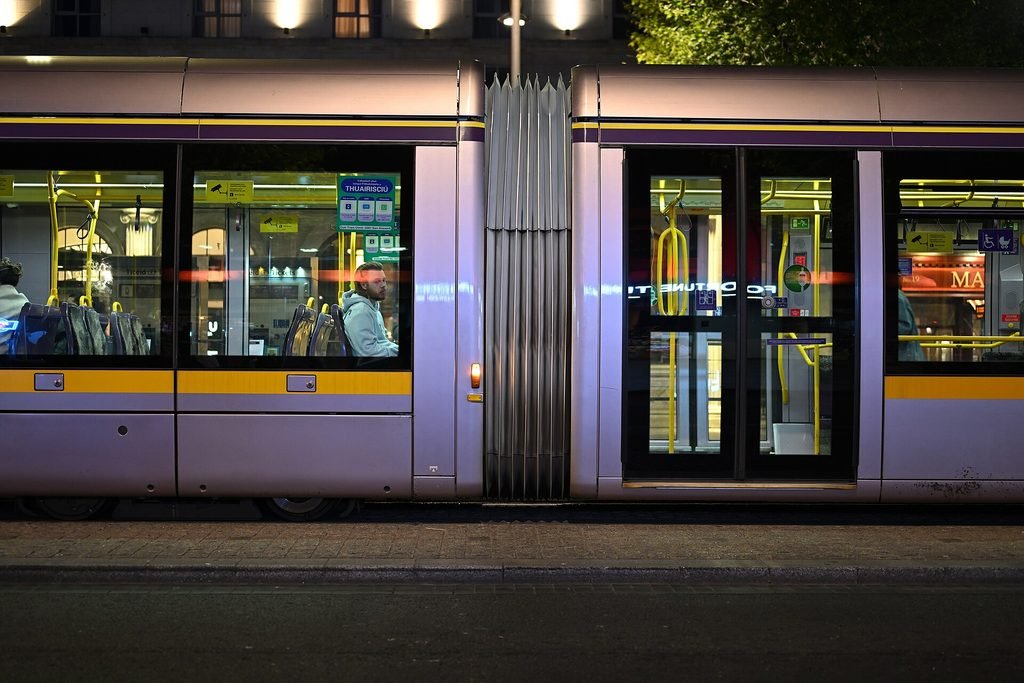
The Luas has two lines. The Red Line runs from Tallaght to The Point and from Saggart to Connolly. The Green Line runs from Brides Glen to Broombridge, through St Stephen’s Green and O’Connell Street. The two lines meet in the city centre, at Abbey Street on the Red Line and Marlborough or O’Connell – GPO on the Green Line, just a short walk apart.
Trams run from about 5.30am on weekdays until around 12.30am (earlier on Sundays).
The golden rule: tap on at the platform validator before you board and tap off when you get off. If you skip it, you risk a €100 Standard Fare Notice. If you forget to tap off, you are charged the full 90-minute fare.
DART and Commuter Rail
The DART is the electric train along Dublin Bay. It runs from Malahide and Howth in the north, through the city centre, down to Greystones in Co. Wicklow. It is the best way to get to the seaside at Howth, Dalkey or Bray. Tap on and tap off at the station gates. Adult Leap users need at least €1 on the card for Zone 1 rail trips.
Watch the zones. Greystones is in Zone 2, so a trip there costs more than the €2 city fare. A Zone 2 Leap train fare to the city centre is €3.90. For routes, stations and intercity tips, see our guide to Dublin’s rail network.
Dublin Bikes and Cycling
The red-and-blue dublinbikes are docked at more than 115 stations around the city. A 1-day ticket is €3.50, a 3-day ticket is €5 and an annual subscription is €35. The first 30 minutes of every journey are free, so hop between docks and you will rarely pay more. The current scheme runs until 2027, when Dublin City Council plans to replace it with a new, larger system.
Want a proper bike for a day out to the coast? See our guide to Bike Stop Dublin bike rental and repairs.
Taxis and Apps: FREENOW and Uber
Every taxi in Dublin is licensed by the National Transport Authority, and fares are capped by law. From 8am to 8pm Monday to Saturday, the meter starts at €4.40. A higher premium rate applies at night, on Sundays and on public holidays. Pre-booking adds a €3 fee, and drivers must offer you a printed receipt.
The apps book the same licensed taxis. FREENOW (now FREENOW by Lyft) is the big local player. Uber works in Dublin too, but only to book licensed taxis. There is no UberX-style private-car service here.
Getting To and From Dublin Airport
There is no train to the airport, so you have three main choices:
- Dublin Express: routes 782 and 784 into the city centre, with fares from €9 online. Note that the old Airlink 747 and 757 no longer run. DoDublin says their stops are now covered by the Dublin Express 782 and 784.
- Aircoach: routes 700 and 700X run 24/7 to O’Connell Street and beyond, about every 15 minutes, from €9 one way online.
- Public bus: Dublin Bus routes 16, 19, 24 and 41 cost €2 with Leap and are covered by the Visitor Card. They are slower and have little luggage space.
- Taxi: roughly €30–€45 to the city centre, according to Aircoach.
For a full stop-by-stop rundown, read how to get to and from Dublin Airport, or book an airport transfer before you land.
Getting Around Dublin on Foot
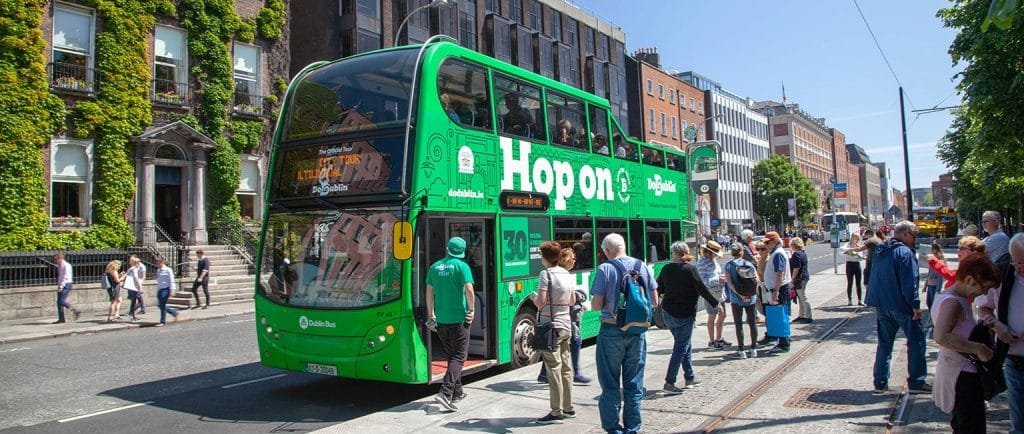
Honestly, walking is the best way to see the centre. Trinity College, Temple Bar, Grafton Street and St Stephen’s Green are all close together. Remember that traffic drives on the left, so look right first. For the bigger sights in one loop, the DoDublin hop-on hop-off tour is a handy option (your Leap Visitor Card won’t cover it). If you are driving in, read our guide to parking in Dublin city centre first. Better still, leave the car at the hotel.
Accessibility
All Luas trams and platforms are fully wheelchair accessible, with level boarding, ramps and lifts where needed. Luas offers free travel assistance if you book ahead. On the DART, Irish Rail staff will put out ramps, and four hours’ notice is recommended. For help booking assistance on any TFI service, call the TFI Contact Centre on 0818 294 015 (+353 1 575 6110 from abroad). The TFI Journey Planner and TFI Live app both show which services and stops are wheelchair accessible.
Apps to Download Before You Go
- TFI Live: real-time departures, timetables, maps and journey planning across Dublin Bus, Go-Ahead, Luas and Irish Rail. The TFI Journey Planner on the website does the same.
- TFI Leap Top-Up: top up, check your balance and see how long is left on your 90-minute fare.
- FREENOW or Uber: for taxis.
Frequently Asked Questions
Is the Leap Visitor Card worth it?
Sometimes. A standard adult Leap Card caps at €6 a day and €24 a week on city services, so it often works out the same or cheaper. Choose the Visitor Card (€8, €18 or €24) if you want unlimited travel without watching your balance.
Can I pay with contactless or Apple Pay on Dublin buses and the Luas?
Not in 2026. Contactless payment on Dublin Bus, Luas and DART is due in summer 2028. Luas ticket machines take cards, but Dublin Bus drivers take coins only.
Does the Leap Card work on airport buses?
Yes, on the public Dublin Bus routes 16, 19, 24 and 41. The private Aircoach and Dublin Express services sell their own tickets.
Do I need to tap off?
Yes on the Luas, DART and commuter rail. No on buses. If you forget to tap off the Luas, you are charged the full 90-minute fare.
Ready to Explore?
Once getting around Dublin is sorted, the whole country is within reach. See our top day tours from Dublin, or browse Dublin city visitor attractions to book ahead. Enjoy every mile of it. Sláinte!
Header photo: 4300streetcar via Wikimedia Commons, CC BY 4.0.

Explore Dublin & Beyond
From historical city walking tours to breathtaking day trips across Ireland. Find your next adventure.
See all tours & activities